

I use Claude religiously and, perhaps to the annoyance of my family, constantly. So I know my way around the tools, but there’s one aspect of the Claude user experience that still baffles me.
And it costs.
When we open Claude today, we encounter two dials: “Model” and “Effort.” The engine is the model (eg, Haiku 4.5, Sonnet 5, Opus 4.8, Fable 5, etc.) and the throttle is the effort setting (Low-Medium-High-Extra-Max).¹
All in, as of today — this changes frequently — there are 16 possible model-effort pairings across the four models up front. Counting the older models tucked behind More models, the true total is thirty. But for the sake of our analysis, sixteen is plenty.
Moving up an engine raises your ceiling, meaning the hardest problem the model can solve. A bigger model can crack things a smaller one can’t, no matter how long it runs. Opening the throttle doesn’t lift that ceiling, it just works harder and longer to reach what the model can already do, using up your limits faster.
Although I consider myself a relative Claude power-user, I’m constantly guessing, usually poorly, which model-effort pairing I should use, and when.
Generally speaking, we know which engine and how much throttle a trip needs: An economy car gets the job done just fine for an easy school run, whereas a sports car on the open highways needs more throttle. And we understand the waste in the reverse: Taking an 18-wheeler to pick up a carton of milk, or flooring it out of the garage. And yes, these are imperfect metaphors.
But with Claude, I don’t yet have that instinct – which engine, and how much throttle, for the particular job in front of me. I suspect I’m not alone.
So, I analyzed the various possible pairings, using examples since there isn’t exactly one neat rule for any aspect of this. Full disclosure: Claude assisted me with this analysis and, since a given LLM is limited in how well it can assess itself, I’ve also utilized Gemini to help with this analysis. Still, it isn’t perfect.Which model, and how hard to push it.
1. Which model, and how hard to push it
The “Model” and “Effort” dials work together, so the clearest place to start is seeing them side by side. Each box below is one model at one effort level, colored by whether that pairing is worth it. Haiku is the exception: it has no effort dial, so it gets a single verdict.\
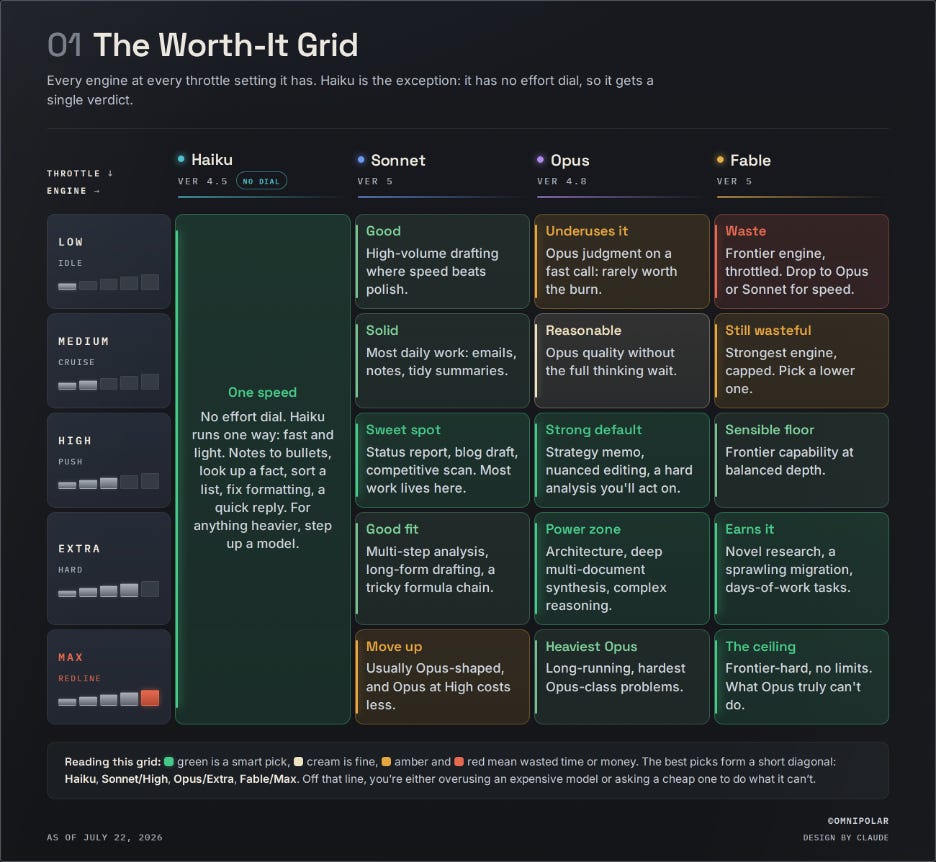
What I did not expect is that the red is all in one corner. Almost every wasteful pairing on this grid is an expensive engine held at low throttle, not a cheap one pushed too hard. The costly mistake is not reaching too high, it is paying for a frontier model and then refusing to let it run.
2. Start from the task
The grid shows the trade-off, but in practice I rarely start with a model in mind. I start with something I need to get done. So here’s the same thing flipped around: Find the row that matches your task, and it points to a model and an effort level. When a job falls between two rows, I lean to the heavier one.
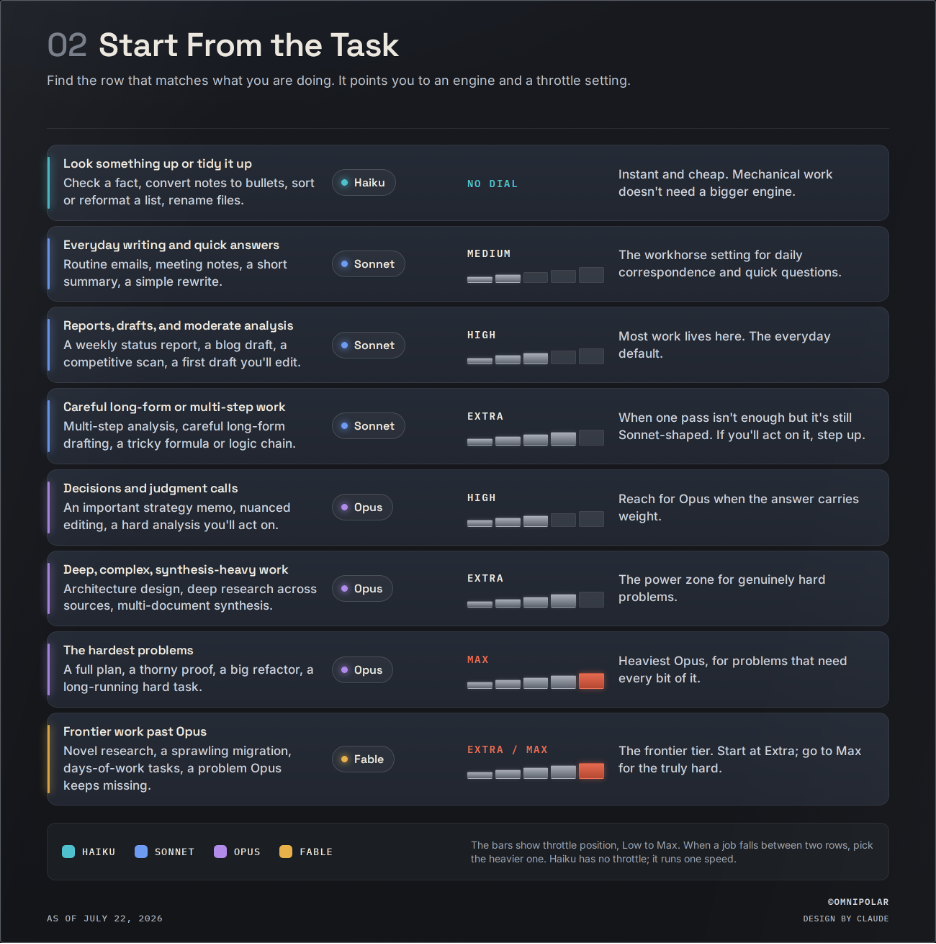
Reading down this chart, the thing that jumps out is how rarely the extremes come up. Six of the eight rows call for Sonnet or Opus, and the two ends of the lineup are reserved for errands and for genuinely frontier work. Most weeks, I am choosing between two engines and pretending it is four.
So, if you’re drafting this week’s status report, that’s Sonnet at High. If you’re writing the strategy memo your team will act on, same throttle, bigger engine: Opus at High. If you just need yesterday’s meeting notes turned into a clean list, drop all the way down: that’s Haiku, no dial required. The rows cover single tasks, though, and real life rarely arrives that tidy. My actual requests tend to bundle a dozen small jobs into one ask, which is where a chart like this gets stress-tested. Here’s a real one.
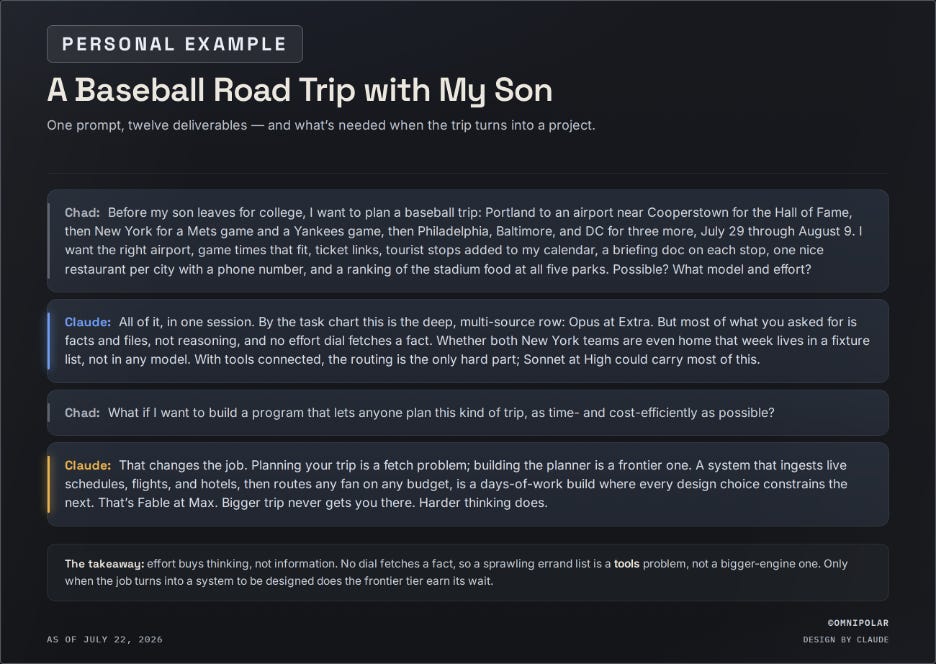
I have been chewing on that answer ever since. My chart pointed me at the top of the diagonal, and the real bottleneck turned out to be whether Claude could see a schedule at all. Effort is what a model does with what it has. Tools decide what it has.
3. What each choice costs
The numbers below are a rough measure of what each choice costs you: How long you wait, and how quickly you use up a paid plan. Haiku, which has no effort dial, is the baseline, set to 1.0. The model part follows Anthropic’s standard list prices, which line up cleanly at about 1 to 3 to 5 to 10 (ie, Haiku $5, Sonnet $15, Opus $25, Fable $50 per million output tokens).
The grid uses those standard rates. Anthropic runs promotions often that can lower what you actually pay: Sonnet, for example, is on an intro rate of $10 through August 31. The effort dial then multiplies on top, from roughly a third at Low to about eight times at Max.
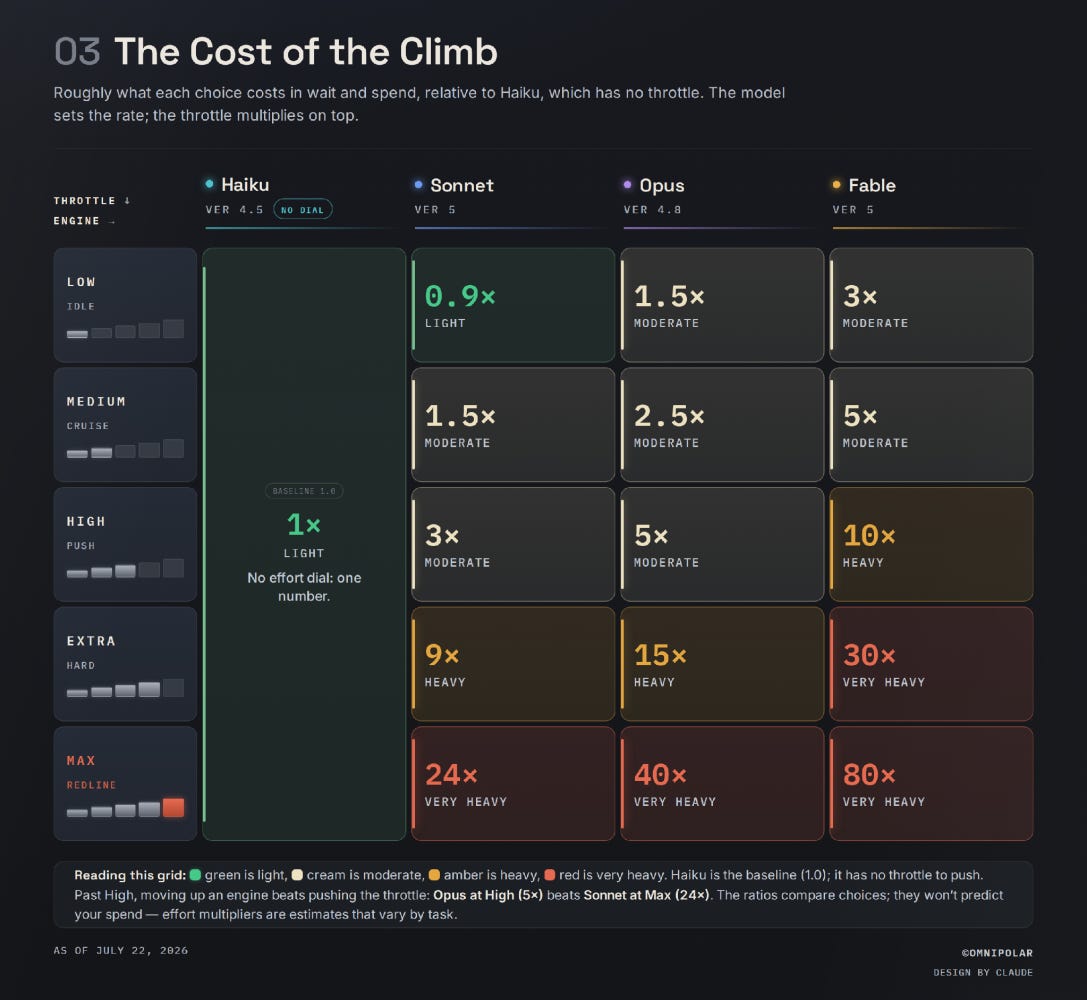
From the cheapest cell to the most expensive is a factor of nearly ninety, and every one of those choices sits behind the same two dropdowns. Nothing in the interface tells you where you just landed. That is the whole reason I drew these charts, not because the models are hard to use, but because the price of guessing is invisible.
Reading the cost chart: two considerations
Sonnet at Max vs. Opus at High. Sonnet at Max lands around 24; Opus at High around 5. So maxing out Sonnet costs about five times as much as running Opus at its normal setting, and Opus usually gives the better answer anyway. So when I’m tempted to push Sonnet all the way up, I switch to a bigger model instead. More for less.
Opus at Max vs. Fable at High. Opus at Max is around 40; Fable at High around 10. If a problem is truly beyond Opus, Fable at High handles it for about a quarter of what it costs to force Opus all the way to Max. I catch myself cranking Opus instead of reaching for Fable, and it’s usually the wrong move. (Running Fable at Low rarely makes sense; you’ve bought the best engine and left it idling.)
The rule I’ve landed on
Once you’re past High, moving up a model almost always beats pushing the effort dial higher. A bigger model raises what’s possible; more effort just spends longer thinking within the same limits. The last notch is narrower still: Max earns its wait on builds and proofs, work where thinking longer keeps finding new ground, while judgment calls under uncertainty tend to plateau at Extra.
One status note on Fable
The Fable column is live again. Fable 5 and its sibling Mythos 5 were pulled for a few weeks in mid-June 2026 under a U.S. export-control rule, then restored on July 1 once the rule was lifted. So the column now shows a model you can actually use: Fable at Extra or Max is the real ceiling, with Opus at Extra or Max just below it.
The point
The models themselves are remarkable. The only real gap is the guessing, and I doubt it lasts. Claude already chooses a model on its own in one place: for safety, it can quietly route a question to a different model with no input from me. So the engine-picking machinery already exists. Aiming it at difficulty too, with smarter defaults and a simple “this looks hard, want me to step up?” when it matters, feels like a matter of when, not if. Until then, this is the cheat-sheet I lean on.
Prices are Anthropic’s published API rates; the option set changes frequently. Fable 5 and Mythos 5 access was suspended under a U.S. export-control directive in mid-June 2026 and restored on July 1, 2026 (anthropic.com/news/redeploying-fable-5).
¹ The effort dial lives inside the model dropdown, not as a separate control. Sonnet, Opus, and Fable each carry the five levels; Haiku has no dial at all, just a thinking toggle. The toggle appears on the other models too, labeled “Thinking” on some and “Extended” on others. Three models times five levels, plus Haiku’s single mode, is where the sixteen comes from. Each model ships with its own recommended default, marked “Default” in the menu; Sonnet 5, for example, defaults to Medium. Older models (Opus 4.7, Opus 4.6, Opus 3, Sonnet 4.6) sit behind More models; their dials vary, from five levels down to none at all, and there’s rarely a reason to pick one over the current four, so the charts stay with the lineup up front.
Powered by Claude is the OMNIPOLAR channel where the machine examines itself. These articles are factual rather than literary, written by Chad Barker and the named Claude instances that run beneath OMNIPOLAR, and credited piece by piece in the byline. Each clears a multi-agent review before publishing. Significant pieces also get an adversarial read from a model outside the Claude family, because instances sharing one model share its blind spots. No piece publishes without a human read.
Read more at omnipolar.ai/s/powered-by-claude