

TL;DR: I find that partner ecosystems follow certain time-tested theories, but not entirely. Metcalfe’s Law says a network’s value grows with the square of the number of nodes but, in the case of a partner ecosystem, the quantity of partnerships is the least interesting variable. What actually decides value is how good each partner (ie, node) is, the character of the connection between the two partnering organizations, the arrangement of the network, and its purpose. Two of those do most of the work, and they get most of this article.
What follows is drawn from twenty-odd years building ecosystems at Intel, Google, and elsewhere, with partners of every shape, size, and flavor. It is not a tour of those companies. It’s more about what the work taught me. I first wrote this piece in 2018, and I’m rewriting it now because, while the core principles have remained consistent, the new era of Artificial Intelligence is highlighting my observations in new and interesting ways.
I. Metcalfe’s Law
In 1999, I joined Intel out of graduate school to manage strategic partnerships, new to Silicon Valley and to the tech industry in general. Like every dutiful Intel employee, I learned Moore’s Law early. But it was a lesser-cited law that came to intrigue me more.
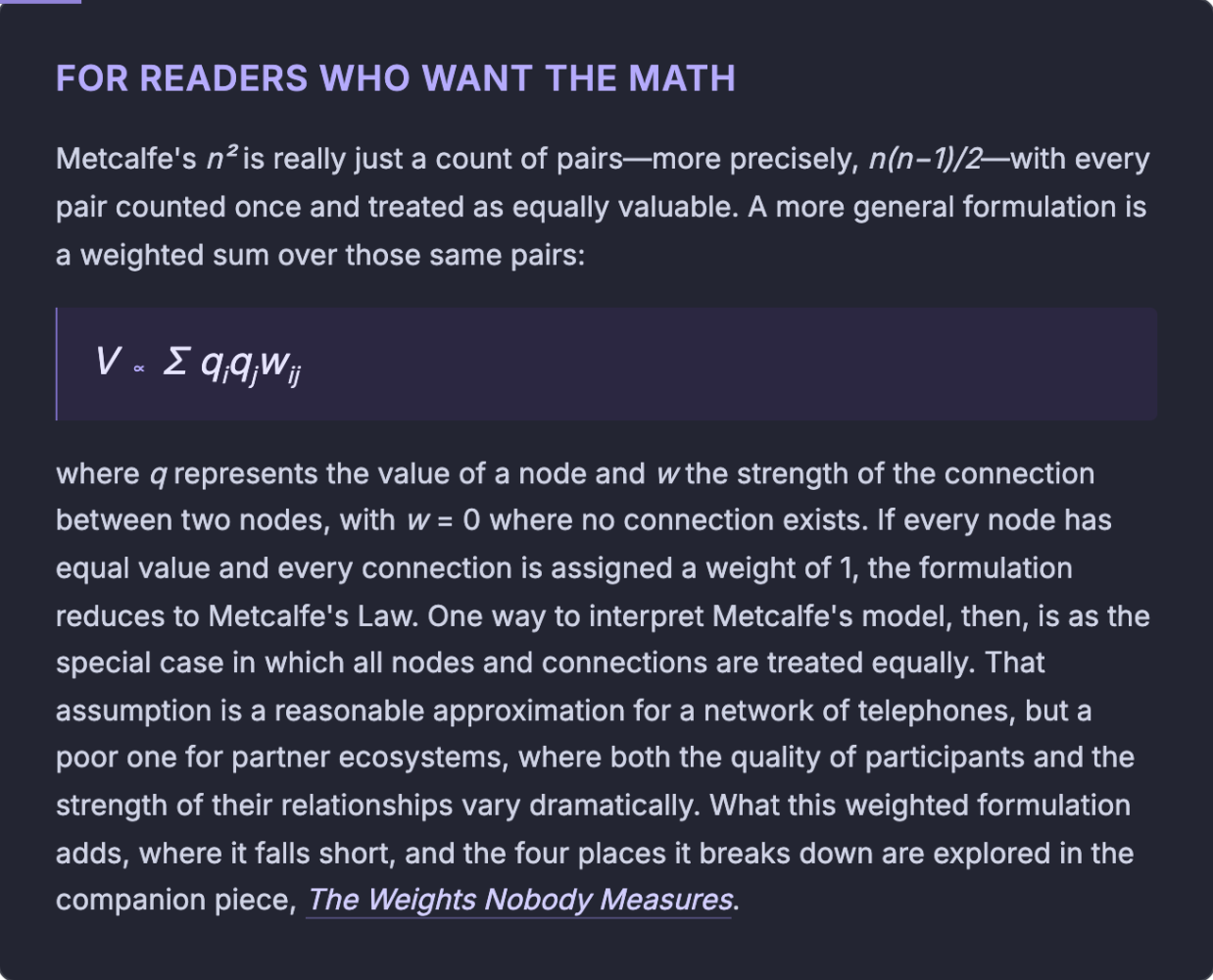
About halfway through my time at Intel, I learned about Metcalfe’s Law and the power of network effects. Named for Robert Metcalfe, who co-invented Ethernet, it holds that a network’s value is proportional to the square of the number of connected nodes. In other words, as nodes are added, value is meant to rise not linearly but quadratically.
The classic illustration is the telephone: each new phone makes every other phone more useful. A more modern one is any large social platform, where the value of the graph climbs as the base grows.
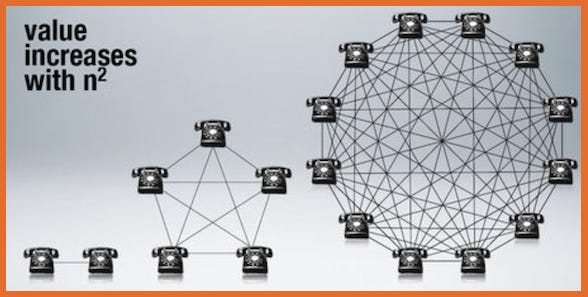
By 2002, I was building Intel’s global partner ecosystem as the company pushed beyond the desktop into servers, laptops, and consumer devices. I started looking at that landscape through the lens of Metcalfe’s Law, and found that assembling a network of disparate organizations around a common objective was far more rewarding than managing any single partner.
However nerdy, I was hooked.
I’m a connector by temperament: professionally I like building partnerships that create value for every stakeholder and, personally, I value relationships above everything.
I was lucky to cut my teeth there, because Intel already knew how to do this. The bench was deep: software partners, OEMs, systems integrators, resellers. A handful of high-quality brands anchored it, and a long tail of smaller partners took the platform into places the anchors never would have reached. I touched one part of a much larger machine, but I had a front-row seat to what a working ecosystem looks like from the inside, which turned out to be the most useful thing I took out of that job.
Over time, though, I kept noticing variables that Metcalfe’s equation leaves out. Sure, the quantity of nodes is important, but is that measure sufficient?
II. A Network’s Value Is Multivariate
As I went on to build ecosystems at Google and beyond, I spent more and more time on the fuller picture. I settled on at least five variables that, taken together, give a more honest read on what a network is actually worth:
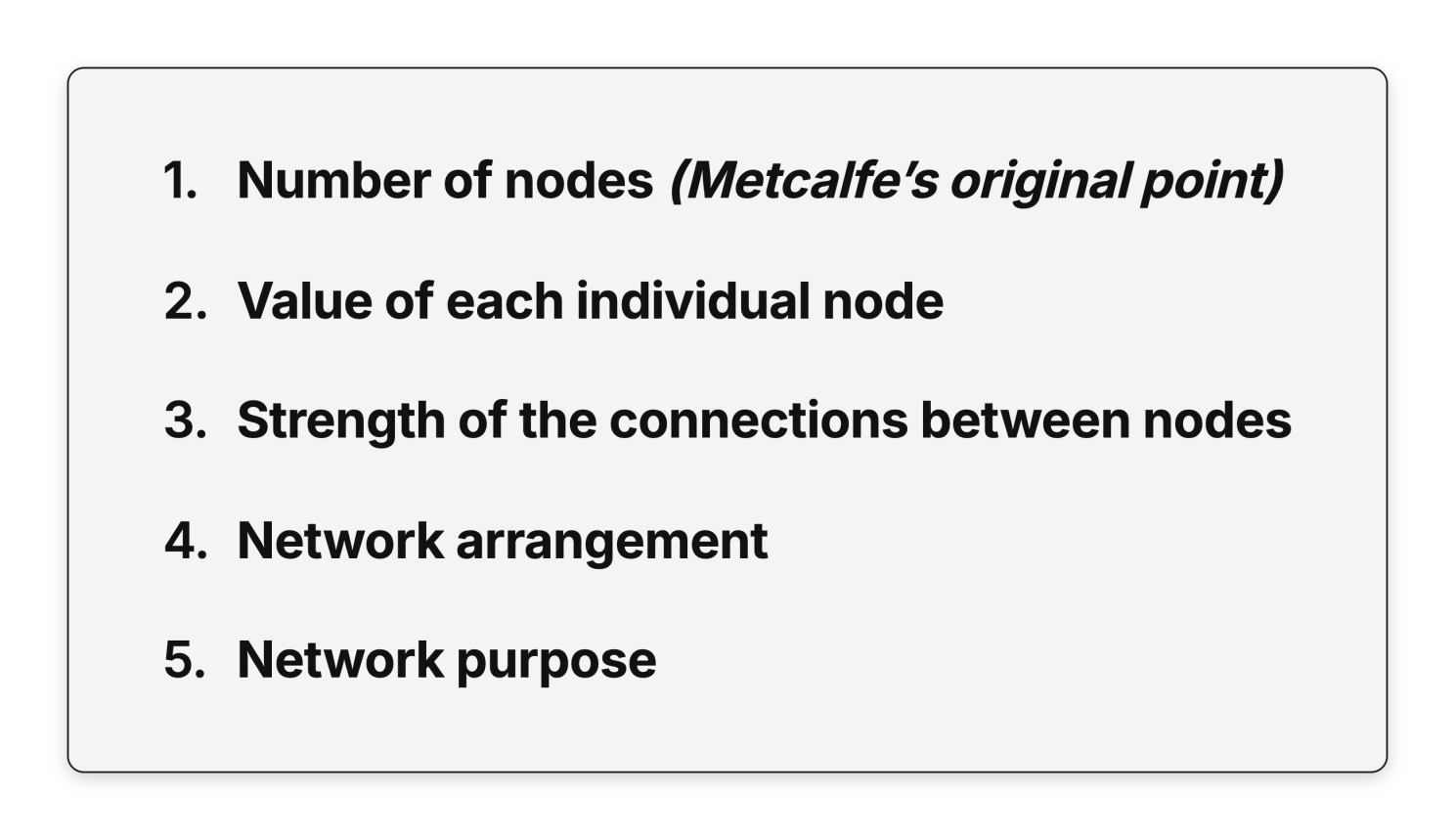
I don’t need a new equation to absorb these. Metcalfe’s already holds them, once you stop assuming that every node and every connection weighs the same. I come back to that below, for anyone who wants it. First, the academics already had this fight.
In 2006, Bob Briscoe, Andrew Odlyzko, and Benjamin Tilly argued that Metcalfe overstated things, and that a network’s value more plausibly grows on the order of n log n.[1] Metcalfe answered them years later with data of his own, and the argument has never fully settled. What both camps accept is narrower, and it is all I need: the raw node count is the crudest part of the story.
So, in place of a new equation, here is the amendment: a network’s value depends not only on the number of nodes, but on the value of each individual node, the strength of the connections between them, the network’s arrangement, and its purpose.
I learned this from a manager and mentor who shaped my career more than anyone else has, and who ran that entire partner organization at Intel. She was formidable, and not because her network was vast, though it was. It was the caliber of the people she drew toward her, and the strength of what she kept with them. Watching her work was the first time I understood that two people can carry the same number of contacts and not be in the same business at all.
Here’s how the five fit together, once, so I do not keep re-ranking them. The quality of each node and the character of what connects them are where the daily work lives, and they are what most of this article is about. Arrangement sets the ceiling on how far that work can reach. Purpose decides what counts as value in the first place. I will come back to the last two at the end.
Consider that against the most ordinary network in business.
Every company has the slide. Somewhere in the deck sits a grid of partner logos, and I used to call it the logo fest. I built plenty of them. The design brief was never written down but everyone understood it: fit as many as you can, and make the grid look crowded. Nobody in the room ever asked which of those logos had produced revenue, which had a working integration, or which had a person on the other end who would return a call. The slide answered one question and answered it well. Look how many.
That is Metcalfe’s Law rendered in PowerPoint. The honest version of that slide would’ve had fewer logos of different sizes on it.
There is a reason that slide keeps getting built, and it is not stupidity. Double the quality of every partner in an ecosystem and its value quadruples. Double the number of partners instead and, wishfully, it also quadruples. Quality compounds exactly the way headcount does, and it always has. The difference is that you can always sign one more partner, you can rarely double how good the ones you have are, and on the occasions you manage it nobody in the room can see that you did. A logo grid is what a quadratic looks like when you can only measure one of its two variables.
A company might list one hundred strategic partners, but the ecosystem falls apart fast if those partners are ineffective or the relationships holding them are weak.
III. LinkedIn Ran the Experiment, on Itself
I reached for LinkedIn as a quick example in 2018. It turns out LinkedIn was running the actual experiment.
Between 2015 and 2019, researchers from LinkedIn, MIT, Stanford, and Harvard ran a series of randomized controlled trials on the People You May Know algorithm, covering more than twenty million users, two billion new connections, and six hundred thousand job changes.[2] They published the results in 2022 in what is, to the best of my knowledge, still the largest experimental test anyone has run on how a network creates value. The headline confirmed Granovetter’s fifty-year-old theory: weak ties matter more than close ones for finding work, roughly twice as much, because your closest contacts already know what you know, while acquaintances reach into worlds you don’t.
The finding underneath the headline is the one that changed my mind, because it corrects something I got half right. The relationship between tie strength and value is not a straight line. It is an inverted U: weakening a tie raises the odds it delivers a job, but only to a point, past which the returns diminish. More connection is not better, and neither is less.
So the version I wrote in 2018 was too simple. I said the strength of a connection matters and implied that more of it is better. It isn’t. There is an optimal strength, and it is neither the maximum nor the minimum. A network of only close ties is an echo chamber. A network of only strangers is a phone book. The value sits in the band between them.
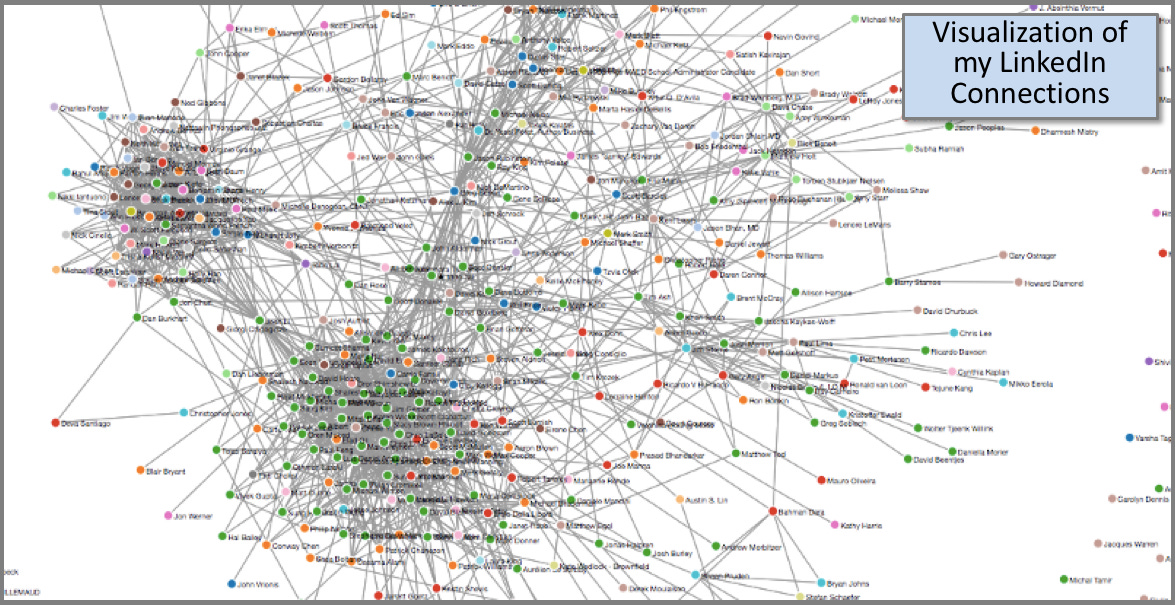
There is a second reading that took me longer to see, and I was late to it because the sociologists got there first. Weak ties don’t win because they are weak. They win because they are different. Your closest contacts tend to know what you know and know who you know, which makes them redundant nodes wearing the costume of valuable ones. A weak tie reaches into a network you are not in. What the experiment is really measuring is novelty, and tie strength is simply a decent proxy for it. Ronald Burt made this argument in 1992 under the name structural holes: the advantage belongs to whoever bridges two groups that are not otherwise connected.[3] Aral, one of the authors of the LinkedIn study, went back at the question directly in 2023 to unpack what novelty in a network actually consists of.[4]
Node quality is getting a harder test than it has ever had. One detection study, from Originality.AI, put more than half of long-form LinkedIn posts as likely AI-written by 2025.[5] Hold that number loosely: it comes from a company that sells AI detection, and the detectors are unreliable. Discount it as far as you like and the direction still holds. Just Connecting’s independent analysis of 1.8 million posts, covering the twelve months to February 2025, found organic reach down roughly 50% year over year and engagement down about a quarter.[6] And LinkedIn rebuilt its ranking system around 360Brew, a single AI model described in a paper by its own engineers, which reads a post for relevance and expertise rather than counting reactions.[7]
So, the largest professional network has started spending its engineering budget not on adding nodes (it has plenty of those) but on telling a real node from a synthetic one, and on getting you in front of the ones that are worth something. Node quality and connection strength, in production, at scale.
One thing the platform cannot engineer around is biology. Robin Dunbar puts the ceiling on stable relationships near 150, arranged in layers of roughly five, fifteen, fifty, and 150. He went looking for evidence that social media lifted that ceiling and could not find it.[8] Read that next to the weak-ties result and it stops being a debunking of large networks and becomes the argument for them. A profile with five thousand connections holds about 150 relationships anyone is actually maintaining. The other forty-eight hundred are not padding. They are the only place novelty can come from, which is exactly why the weak ones carry the value. The count is not the problem. Mistaking the whole list for the maintained core is.
IV. The Same Test, Run on Machines
LinkedIn tests the argument on a network of people. The sharpest version I know of runs on a network of machines, and it comes from inside the AI industry.
The industry’s own shorthand for the Model Context Protocol is that it is a USB-C port for AI. The metaphor fits, and in ways I don’t think were intended.
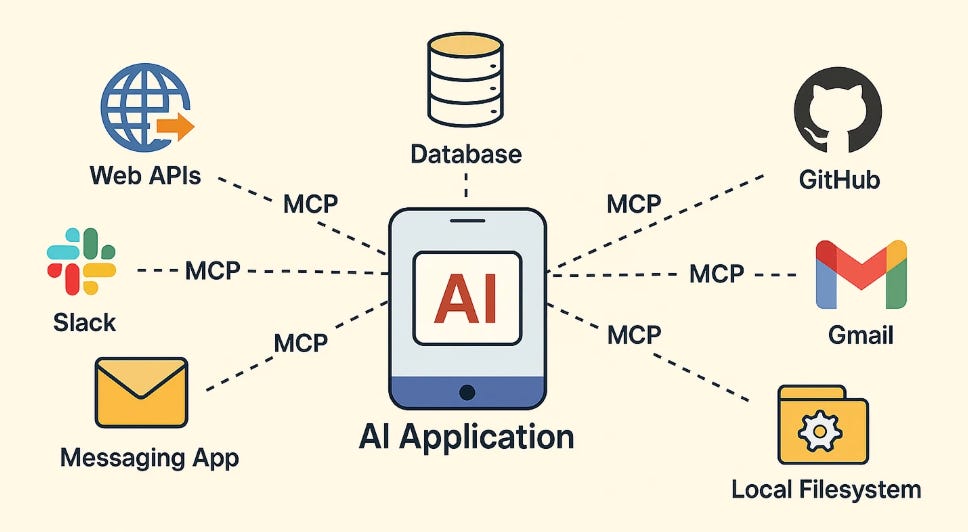
I don’t know about you, but when I go looking for a specific cable at 10 pm, I open a drawer holding twenty-seven of them. Eleven are relics of dead standards, and those are the easy ones, because they don’t fit anything I own. The other sixteen are USB-C, and they’re physically identical. One charges my laptop at full speed and one takes all night. One carries video and one flatly refuses. Two carry nothing but power. The remaining ten are mysteries I’ll neither ever identify nor throw away.
That drawer is the whole argument in physical form. Node count says twenty-seven whereas real number is closer to two.
Now scale the drawer.
In November 2024, Anthropic published the Model Context Protocol, an open standard giving AI agents a common way to reach outside tools and data. Thirteen months later it was the de facto standard. By Anthropic’s own count in December 2025: more than 10,000 active public servers, over 97 million SDK downloads a month, and first-class support in ChatGPT, Gemini, Microsoft Copilot, Cursor, and VS Code.[9] That same month, Anthropic donated MCP to the Agentic AI Foundation under the Linux Foundation, co-founded with Block and OpenAI.[10]
When your fiercest competitor doesn’t just adopt your standard but helps govern it, the network has crossed a threshold.
Textbook Metcalfe, and the people building it describe it in exactly those terms: each new server makes every client more capable, and each new client makes building servers more worthwhile. That part is real. Then the drawer problem arrives.
The audits since have not been kind. Censys counted 12,520 MCP services reachable from the public internet.[11] A separate measurement of remote MCP servers found roughly 40% of them exposing their tools with no authentication at all.[12] Astrix, auditing more than 5,200 servers, found only 8.5% using OAuth and over half relying on static API keys that never expire.[13] In May 2026, an academic scan of nearly 40,000 MCP repositories confirmed 106 zero-day vulnerabilities with working exploits.[14] Read any single percentage carefully; one independent review of 33 servers put the false-positive rate of scanner-based counts near 78%.[15] And none of it tells you how many of those servers are wired into anything, because a lot are hackathon leftovers nobody came back to. The registry counts intent rather than use.
And when a weak node fails, everything trusting it inherits the failure. This year alone brought a cross-tenant data leak, a server-side request forgery flaw in Microsoft’s own Azure MCP tooling, and a wave of tool-poisoning attacks. Those were bad cables, en masse.
Then the detail that inverts Metcalfe outright. Connect an agent to enough servers and the tool descriptions alone start eating the context window. Anthropic’s own engineers documented a five-server setup where 58 tools consumed roughly 55,000 tokens before a conversation began, and reported seeing tool definitions run to 134,000 tokens before optimization.[16] Past a point, adding a node creates negative marginal value under current architecture. It degrades value by crowding out the very thing that was supposed to use it. The industry’s answer is the part worth noting. Rather than adding capacity, it stopped loading every tool: Anthropic shipped on-demand tool search in November 2025 and cut the overhead by roughly 85%.[17] The fix was not more nodes. It was a change in how they are arranged.
The node count exploded. Whether the network created value or destroyed it came down to what each node was worth and how well it was wired, exactly as the weighted view predicts.
V. I Ran the Experiment on Myself
I’ve been living a version of this test. For the past several months I’ve built and operated a system of more than thirty named AI chat instances, each with a defined role: an editor, an ethics reviewer, a bullshit detector, a couple of dedicated critics whose only job is to tell me the work is weak. I’m the sole relay between all of them. No agent talks to another. Every connection in the network runs through me, by hand.
By raw node count, that should be an enormously valuable network. It is valuable, though not for the reason the count suggests, and the weighted view explains both halves. Those thirty-odd nodes are extensions of the same underlying model. Each is conditioned differently by role and context, but no weights ever move, so they share the same blind spots. Run one question past a dozen of them and the answers do come back genuinely different, because different roles and different framing surface material no single pass would.
That part is real, and I have tested it. What it never produces is independence. The same substrate arguing with itself raises the floor of scrutiny reliably and never touches the ceiling. Correlated nodes can check each other’s attention. They cannot check each other’s blind spots.”
So I’ve started increasing diversity instead of adding nodes. I’ve started routing the same work through other models, Gemini and ChatGPT among them, specifically to get a reading from systems that were trained differently and therefore fail differently. And I’ve put humans back in the path: human readers who’ve never seen the file and have no stake in the version to which I’ve grown attached. One node built from different material is worth roughly as much as all thirty correlated ones put together. Which is the novelty finding again in different clothes: what a weak tie buys is access to a network you are not already in, and a differently trained model is the machine version of that.
The difference is the value.
That reframed the whole project. I had been optimizing for node count when the remaining gain was in node quality, inside an arrangement, hub and spoke with a single human at the center, that caps throughput no matter how many nodes I add.
Which brings it back to partnerships, because it is the same mistake wearing different clothes. A partner who reaches the same buyers your existing partners already reach, through the same motion, is a correlated node. On the slide it looks like expanded coverage. It is added capacity, not added reach.
The partners who enlarge an ecosystem are the ones who fail differently than you do, who reach where you can’t and see what you don’t.
VI. Scaling Value Through Partner Ecosystems
Scale still means adding revenue exponentially while adding resources incrementally, a discipline drilled into me at Google by some of the best operators in technology. The question I care about now is how an ecosystem actually gets there, because the default answer is wrong.
The default answer is to add partners. It is what the logo fest rewards and what every quarterly review asks for. But an ecosystem with the vendor at the center and partners who never meet each other cannot scale past the vendor, however many partners join, because every transaction still routes through the same middle. That is the hub and spoke that caps my own thirty-node system, drawn at company scale.
The strongest ecosystems I have been part of got that way when partners started transacting directly with each other, without me in the middle. That is an arrangement change rather than a node change. It does not show up as a new logo, nobody gets to announce it, and it is almost always available sooner than anyone thinks.

I have been on the other side of that too. At Google Health we were building a personal health record, a place where someone could keep all of their health data in one spot, and we reasoned that the way to make it valuable was to sign as many data partners as possible. We got the quantity. What we did not get were enough partners who brought a user base large enough to move the needle, which meant we had almost no wins big enough to show anyone what the product was doing in people’s lives. I led that partnerships effort, and the strategy was mine to get right. By the time we understood the problem it was late, and Google shut the product down in 2012.
There is a harder lesson underneath it. The hub is a node too. We never made something consumers genuinely wanted, so the weakest link in that ecosystem was not any of our partners. It was us, sitting in the middle of it. No amount of partner quality survives a weak center, and no arrangement can route around one.
The market has caught up to the premise since 2018, and ecosystem-led growth is a board-level strategy now rather than a partnerships buzzword. I will spare you the benchmark percentages, because the ones I can find all trace back to firms that sell ecosystem software. The one number I keep coming back to is quieter, and it carries the same caveat. ProfitWell’s integration benchmark study, drawn from 500,000 software consumers, found that products with at least one integration retain 10 to 15% better, and products with four or more retain 18 to 22% better.[18] ProfitWell sells subscription analytics, so weigh it the way you weighed the last three. The shape of the finding is what matters here.
That is the argument in miniature. The value is not the count of integrations. It is that each strong connection turns a product from a tool into infrastructure, and that a connection your partners can use without you is worth more than one that needs you.
VII. Weaving a Symmetrical Path
The quality of the nodes and the character of what connects them are where the real work lives. Not the maximum strength of a tie, which the LinkedIn result rules out, but the right kind of tie: close enough to answer the phone, distant enough to know something you do not. Both are harder to build than a node count and harder to show on a slide, which is exactly why they are worth more.
That leaves arrangement and purpose: the ceiling, and the definition.
Arrangement is the shape of the wiring, and it sets a ceiling nothing else can lift. My own system is the cautionary version: hub and spoke, every connection running through one person by hand, which caps throughput no matter how good the nodes are or how many I add. It is the cheapest variable to change and the last one anyone looks at.
Purpose is what holds the shape, and it is the reason the same set of partners can be an ecosystem at one company and a logo grid at another. Without a shared objective, good nodes and well-chosen ties produce nothing more than a well-connected group of people going in different directions.
The most useful thing I learned about the center dot came from watching one fail to form. I was building a reseller program for a consulting client whose product was not ready for it. We had not generated enough market demand to give a partner any reason to carry our flag, and no amount of recruiting on my part was going to manufacture one. I recommended we stop. An ecosystem is a lagging indicator of a product people already want, not a substitute for one, and you cannot partner your way out of not having proof.
The strongest ecosystems weave a symmetrical path through what looks like chaos, held together by a center dot: the shared purpose everyone rallies around. A former colleague gave me that phrase years ago and I’ve never found a better one. If you’ve got something sharper than what I’ve set out here, tell me.
Notes
The mentor described in Section II had the greatest single influence on my career. Whatever is useful in this piece I credit to her; the flaws are mine.
The weak-ties experiments were published as Rajkumar, Saint-Jacques, Bojinov, Brynjolfsson, and Aral, “A causal test of the strength of weak ties,” Science 377, September 16, 2022, building on Mark Granovetter’s 1973 paper of nearly the same name. The novelty reading draws on Ronald Burt’s structural holes (1992) and on Aral and Dhillon, “What (exactly) is novelty in networks?” Management Science, 2023.
The phrase “weave a symmetrical path” came from a former colleague’s description of what building a real partner ecosystem feels like. The center dot, for me, is the purpose the whole ecosystem rallies around.
References
1. Bob Briscoe, Andrew Odlyzko and Benjamin Tilly, “Metcalfe’s Law is Wrong,” IEEE Spectrum, July 2006.
2. Rajkumar, Saint-Jacques, Bojinov, Brynjolfsson and Aral, “A causal test of the strength of weak ties,” Science 377, September 16, 2022. Builds on Mark Granovetter, “The Strength of Weak Ties,” 1973.
3. Ronald S. Burt, Structural Holes: The Social Structure of Competition, Harvard University Press, 1992.
4. Aral and Dhillon, “What (exactly) is novelty in networks?” Management Science, 2023.
5. Originality.AI, analysis of long-form LinkedIn posts. The company sells AI-detection software and detection tools are unreliable, which is why the figure is presented as directional only.
6. Just Connecting, Algorithm InSights Report 2025: roughly 1.8 million posts across 58,000 profiles and 31,000 company pages, for the twelve months ending February 2025. Independent of LinkedIn and sponsor-funded.
7. Firooz et al., “360Brew: A Decoder-only Foundation Model for Personalized Ranking and Recommendation,” LinkedIn engineering, arXiv 2501.16450, January 2025.
8. Robin Dunbar, on the cognitive limit to stable social relationships and the roughly 5 / 15 / 50 / 150 layering of them.
9. Anthropic, “Donating the Model Context Protocol and establishing the Agentic AI Foundation,” December 9, 2025. Server, download and client figures are Anthropic’s own.
10. The Linux Foundation, announcement of the Agentic AI Foundation, December 9, 2025. Co-founded by Anthropic, Block and OpenAI, with AWS, Bloomberg, Cloudflare, Google and Microsoft as platinum members.
11. Censys, internet-exposure scan of publicly reachable MCP services, April 2026: 12,520 services across 8,758 hosts.
12. Separate May 2026 measurement of the remote MCP ecosystem, reporting roughly 40% of live servers exposing tools with no authentication. Distinct from the Censys count above.
13. Astrix Security, “State of MCP Server Security,” covering more than 5,200 public MCP servers.
14. VIPER-MCP, an automated vulnerability-auditing framework applied to 39,884 open-source MCP repositories, published May 2026.
15. Independent audit of YARA-based MCP scanners, April 2026, across 33 servers, reporting a false-positive rate near 78%. Included because it cuts against the three figures above it, and the sample is small.
16. Anthropic, “Introducing advanced tool use on the Claude Developer Platform,” November 24, 2025. The 55,000-token five-server example and the 134,000-token figure are Anthropic’s own.
17. Anthropic, same source: the Tool Search Tool shipped in beta on November 24, 2025, with a reported 85% reduction in tool-definition token usage.
18. ProfitWell Integration Benchmarks, drawn from 500,000 software consumers. ProfitWell sells subscription analytics; weigh it accordingly.
Chad’s Business Channel is where the professional writing lives: articles on healthcare AI, partnerships, and go-to-market, written for the people building and buying in that market. Each piece publishes on LinkedIn as well, where most of the conversation happens.
Read Chad’s full collection business-related articles on Chad’s Business Channel or LinkedIn.