

The premise is not complicated, and it is not ours. The federal government dissolves. The mechanism is unspecified and unimportant. What remains is the states, no common defense, no arrangement between them beyond what they negotiate themselves, and nobody above them.
You take one. Not a color on a board — the actual place, with the actual people, the actual food it grows, the actual fuel it makes, and the actual ground an army would have to cross to reach it.
Then you find out how you’d do.
Draw your state. Play ‘til the death.

For most of you, this ends badly.
Every number in this game comes from published figures, and nothing has been adjusted to make it fair. Your state is scored on the things that would actually decide it.
Myriad considerations, including:
Can you feed yourself if nobody sells you food? Can you keep the lights on?
Can you turn crude oil into diesel, or do you have oil and no way to use it?
Is there anywhere to retreat to, or is your whole population inside an hour’s drive of the coast?
Can you physically get an army to the other side of the country, and if you got it there, could you supply it?
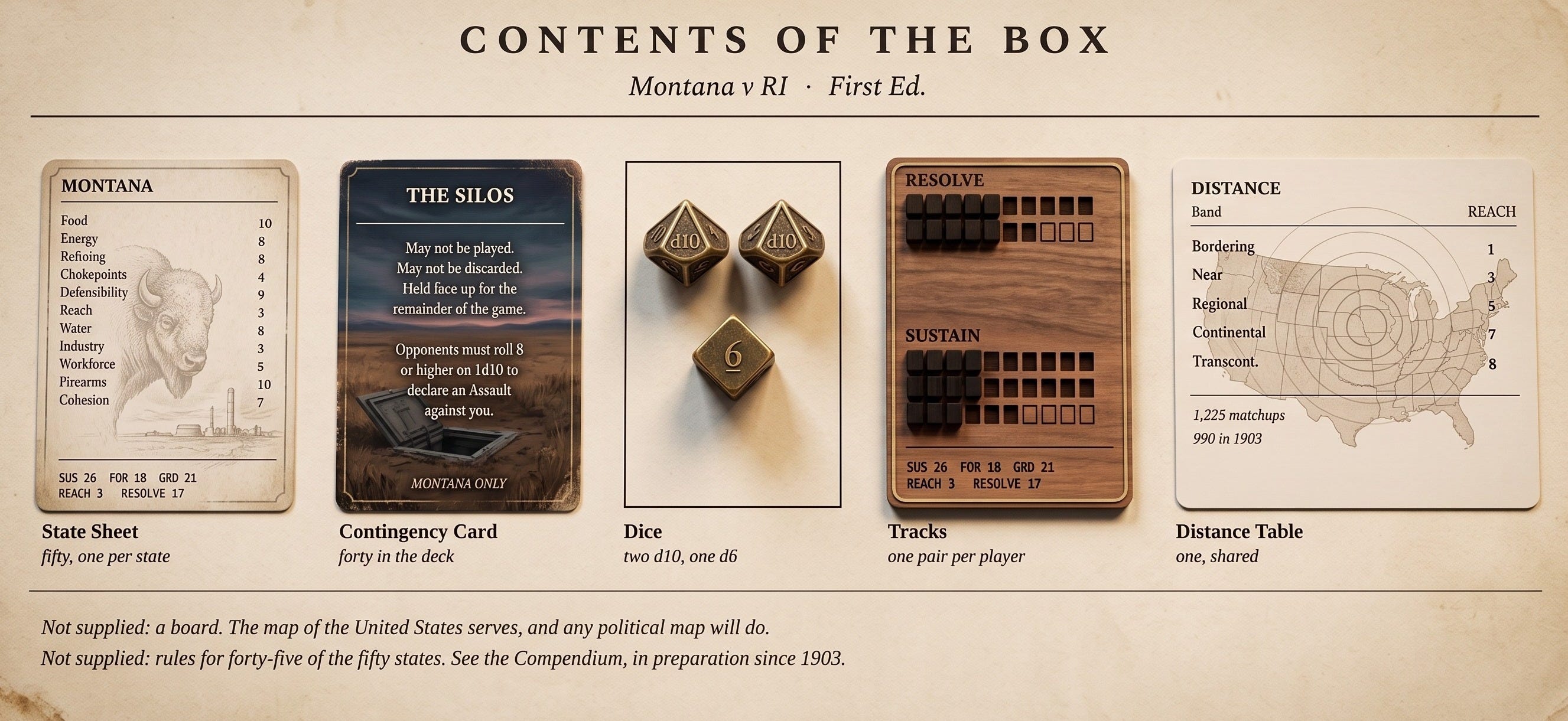
Most states fail two or three of those questions badly. A few fail nearly all of them. There is one state whose greatest asset is a thing no player is permitted to touch, and one whose people are the finest strategic planners in North America and who will need every bit of it.
The game’s name comes from its flagship matchup, and the two states were chosen for reasons that only become clear once you’ve played it. What can be said here is this: by the measure that would seem to matter most, Montana and Rhode Island are the same. Montana has 1,144,694 people. Rhode Island has 1,114,521. The gap is about one Bozeman’s worth of people.
But Montana is ninety-five times larger.
This game’s very real importance lives in that sentence,
We refuse to spoil the rest.
This is a time-honored game
Jedidiah Ames finished it in the spring of 1903, on a farm in Cass County, after six years of evenings. There were forty-five states then, and his table accounted for every pairing the Union admitted — nine hundred and ninety contests, computed by hand. He left two columns blank against the admission of the western territories and died in 1918 without filling them.
His papers came out of the farmhouse attic in 2019. The family has spent the seven years since adding states to a game that was finished when its author died.
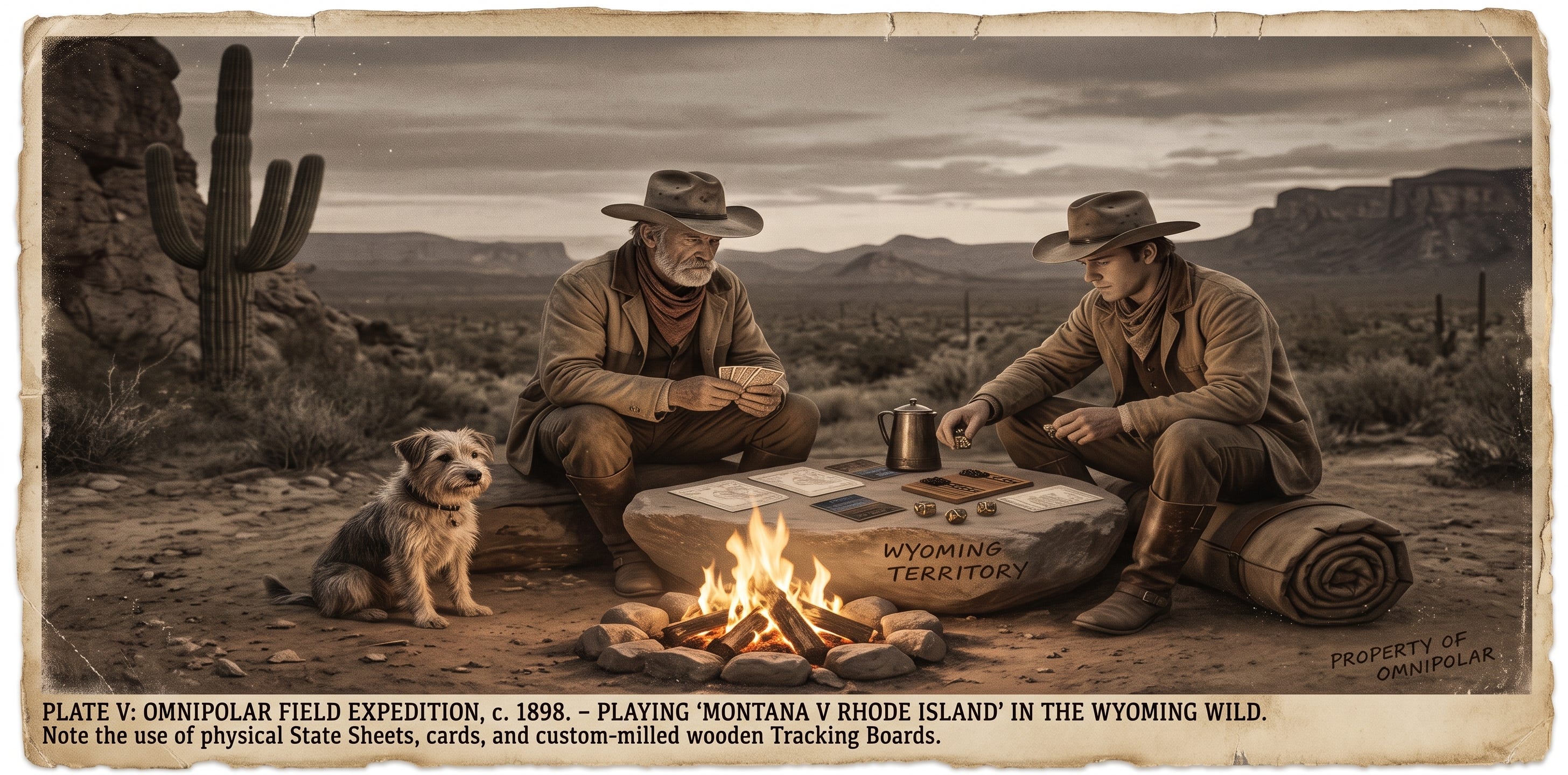
To learn more about the lore surrounding this time-honored game — about risk and reward, joy and sorrow — read Montana v Rhode Island: The History.
On Risk, since everyone asks.
Risk is a game about armies. This is a game about whether you can feed them. In Risk, Kamchatka is a space on a board; here, Kansas is a real place with an enormous amount of wheat and no good way to defend any of it. Risk hands every player identical pieces and lets skill decide the rest. This game hands you what your state actually has, and then tells you plainly, in the third paragraph of the rulebook, that if you’ve taken Rhode Island against Iowa you have already lost and no amount of cleverness will retrieve it.
Risk settles fights with dice. This one often settles them with the question of whether your opponent has a port.
There’s a trivia element as well, on the principle that you cannot successfully invade a place you know nothing about — a principle the historical record broadly supports. Before you attack a state, its player asks you a question about it. Get it wrong and you go in weaker than you meant to. Questions about the state bird are permitted but considered poor form, on the grounds that it is the only one anybody knows.
Who plays this?
Someone comfortable losing to circumstance rather than to a rival. Someone who finds it interesting rather than maddening that most states in this country could not, under any conditions, get an army more than a few hundred miles from home. Someone willing to sit with a slow situation and watch it arrive, on the theory that watching it arrive is the honest part.
Risk rewards aggression. This rewards patience, arithmetic, and a tolerance for the unfair. It is not a game for people who like to win. It is a game for people who like to be right, which is a different and considerably lonelier pleasure.
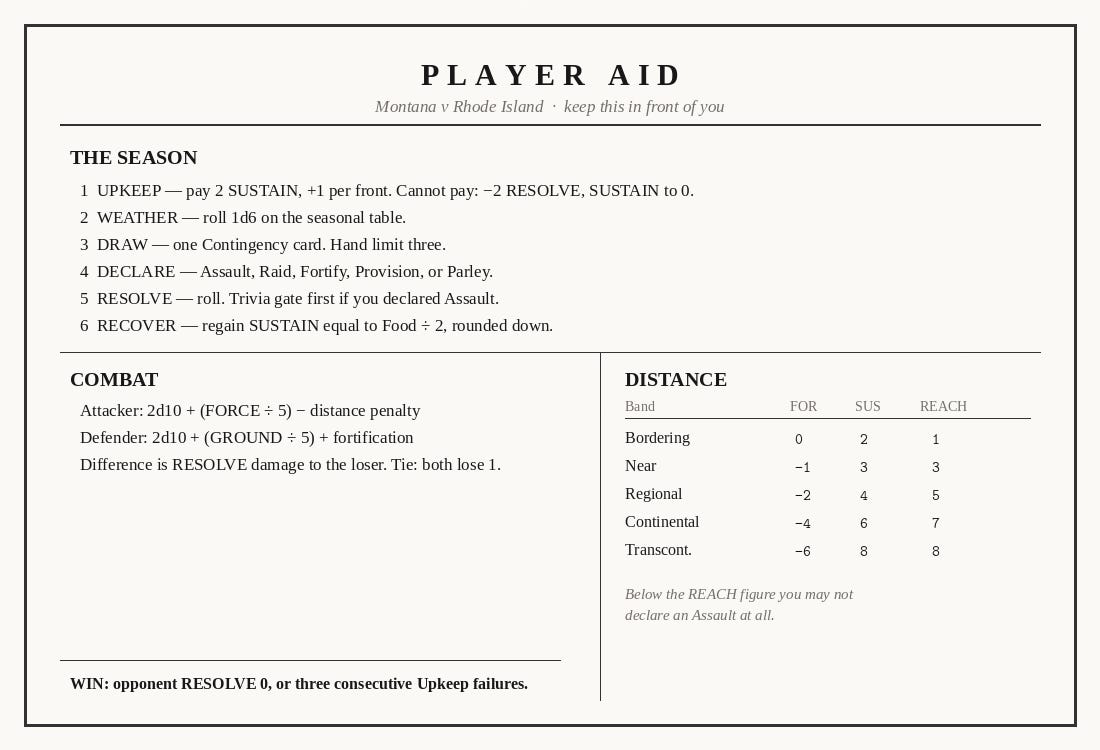
Does it really take 3 years to play?
If you play it right: Yes.
Two neighboring states: about forty minutes. Two distant ones: an hour, give or take. Four players: two hours, and the alliances become the whole game — the rules permit any member to be expelled by majority vote of the others, for no stated reason, so four-player games are mostly about not being the third person in anything.
Ten players: eight hours — a weekend, and plan meals. All fifty states at once: sixty-two hours, which is theoretical, and would require fifty people who have all read a twenty-three-page rulebook, which is not a thing that exists.
Playing every possible matchup once, at one per day, takes three years and five months. Nobody has done this.
We do not recommend beginning.
Or do we.
What states would you like to see battle?
If you’re interested in a simulated battle between two states, click this button to send us a message with the names of the two states in the subject line.
Audience of One is where things get made for a single person. Everything here was built to make one specific reader laugh, and that reader is never named — so anyone who finds it is free to suspect it might be them. The work is deliberately disproportionate to its purpose: forty thousand museums on one page, a 1,518-page thesis on ornamental shrimp of which one chapter exists. The concept, the development and the execution are the enjoyment, and the only measure is whether the person it was for laughed.
For more, visit omnipolar.ai/s/audience-of-one