

I use Claude throughout my day, every day, to the annoyance of my wife and kids. I’m not an engineer. I have a corporate career in partnerships, I run a nonprofit, I write a lot, and I make custom songs for friends.
I’ve been learning my way around these tools as an average person who opened a chat window for something simple and kept going until it became the way I work across all aspects of my life.
Maneuver Claude, don’t just drive it
What I keep finding is that the gap between a mediocre result and a genuinely good one has almost nothing to do with the model and almost everything to do with how we maneuver it. Which model you pick matters, and I have written a whole article (“Claude’s Engine & Throttle”) about exactly how much. But it hasn’t been the thing that separates my good results from my mediocre ones.
I’ve found that the difference is what we ask, how hard we press, and what we’ve set up around it.
Anyone can drive. Driving is operating the machine: gas, brake, stay between the lines. Maneuvering is reading the situation and choosing the line through it, and those are different skills. Most of us are driving Claude when we should be maneuvering it.
This is the first of a series of articles about how I maneuver Claude, and it covers the part that happens before Claude has said anything: getting what’s in your head into the window in a usable form.
I learned most of what follows by first getting things wrong. Fortunately, none of it requires knowing how any of Claude works under the hood. I certainly don’t.
If any of it is useful to you, consider it yours.

1. Ask for what you actually want.
When you sit down, consider the sky the limit and ask for exactly what you want, no matter how unreasonable your prompt sounds. Describe to Claude what your end vision is, even if you’re unclear of your complete vision. Share whatever you can, and add that you need ideas and questions to help you get there.
Think as big as you can and let Claude tell you no. And when it does, ask why not. You’ll find out its limitations, which are usually narrower than you might assume.
It took me a long time to realize how small I was thinking. Then I started making increasingly outrageous requests – work I couldn’t imagine requesting from another person without being certain they’d look at me like I had two heads.
One afternoon years ago, well before any of this, my nephew and I jokingly invented a ridiculous board game called Montana v. Rhode Island [–> Montana v Rhode Island article], in which the federal government dissolves and the fifty states are left to battle each other. Long since forgotten, something reminded me of it, so I decided to write a couple of spoof articles. Then, to extend the joke for my nephew, I took our made-up rules to Claude Code, a separate Anthropic tool for building software that I’d never used, and asked it to ingest the similarly spoofed MvRI player’s manual and build a computer game. It took Claude Code a long time and a lot of turns, but it did indeed produce a functional, if ridiculous, video game.
The game stank. Nobody else will ever play it. But I sent it to my nephew and he laughed, which is all I wanted.
What I realized: if the prompt works, it works. If it doesn’t, I revert to wherever I was before I reached too far. What it costs is usage, and if you’re anywhere near your plan’s limits that’s a real cost.
2. Talk instead of type
I dictate 80% of my inputs, and the reason is friction.
We tend to speak faster than we type, but speed is the smaller half of it. Typing invites correction. You watch the words appear, you see the typo, you go back, and somewhere in that small loop the thought you were chasing gets away from you. Speaking doesn’t offer you the chance. You just keep going, and what you were actually thinking ends up in the window instead of the tidied version of it.
It also means an idea costs almost nothing to capture. I can be walking, have a thought, spend twenty seconds on it, and carry on with my day. That barely qualifies as an interruption, and it is the difference between the idea existing and the idea evaporating.

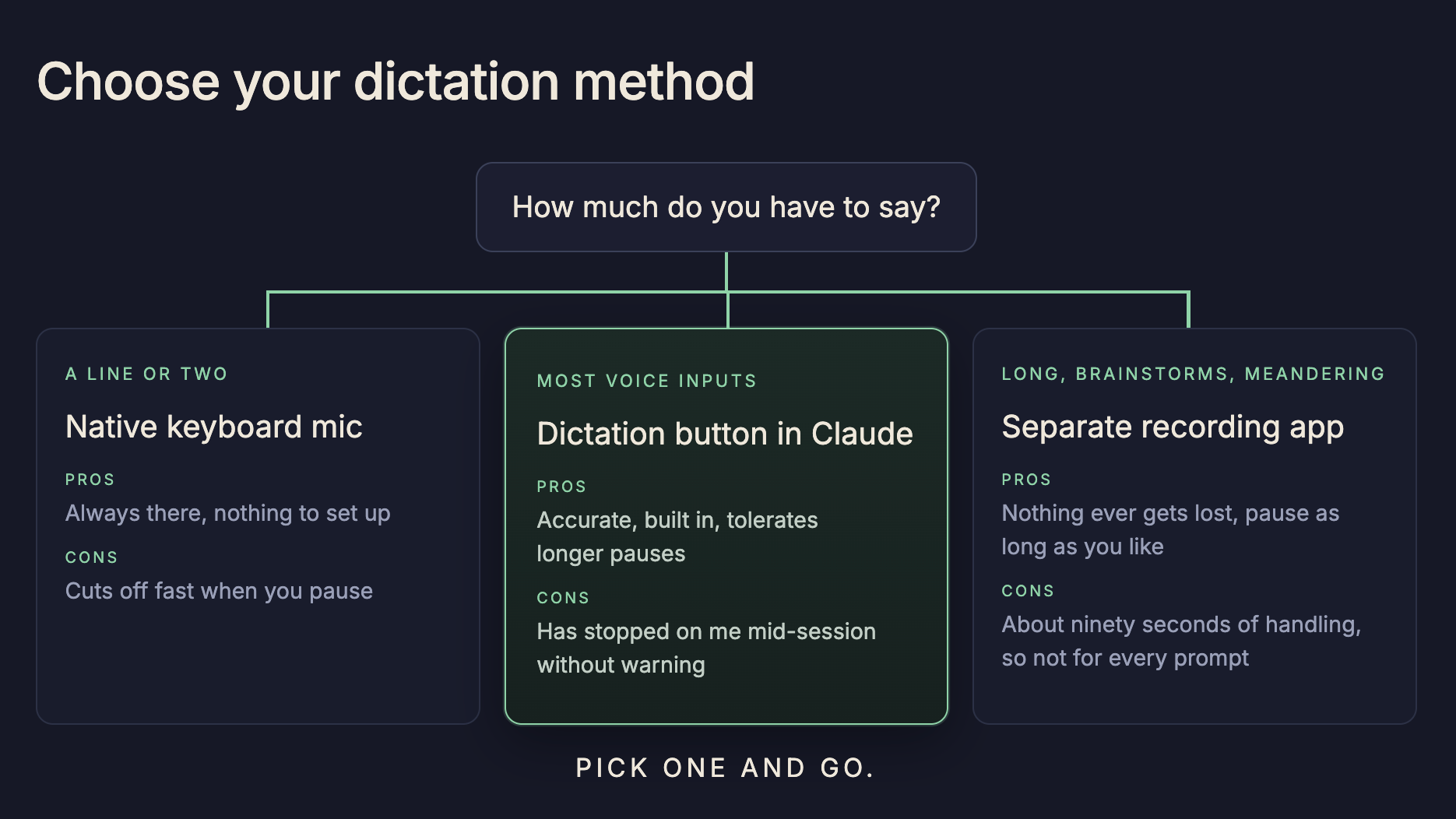
There are three ways to do it, and they are for different jobs.
Your phone’s built-in dictation is fine for a line or two. It shuts off quickly when you stop talking, which trains you to speak in sentences you’ve already composed in your head, and that defeats the purpose of everything above.
The button inside the Claude app is where almost all of my dictation happens. It’s built in, and in my experience it hears me better and gives me more room to pause. It feels awkward for about a week and then becomes second nature.
For anything long or exploratory, I use a standalone recorder, transcribe it with any of the free tools, and paste the transcript into Claude. Long means a whole article dictated on a walk. Exploratory means brainstorming with real pauses in it, or reading something aloud and reacting as I go. It costs me about ninety seconds of actual handling, whatever the recording’s length, which is quick but not quick enough to do on every prompt.
That’s the whole decision. Two words or a sentence, use your phone. Almost everything else, use the app. Long or rambling or read-aloud, use a recorder.
Two limits are worth knowing, and I want to be careful about what is confirmed and what is my own experience.
The in-app dictation stops on its own sometimes, and it does not tell you. On my laptop a long pause seems to end it, and once it has stopped you cannot simply resume; you have to send what you have and start a new message to keep going. I have also had it stop during longer sessions for no reason I could see, and my rough sense is that it will not run much past ten minutes, though I have not been able to confirm that and Anthropic does not publish a limit for the app that I can find.
What is documented, for a different product, has the same shape. Claude Code’s voice dictation is specified to stop after fifteen seconds of silence or two minutes total, and neither can be adjusted. There are open requests asking Anthropic to make both configurable, one of which describes the problem exactly: fifteen seconds is short when you pause to think, so the recording ends mid-thought and you are left stitching the pieces back together. That is not the same tool I am describing, and I want to be careful about what it proves. Documented limits in one product tell you nothing about why a different one stops. The app cutting out on me remains unexplained, and public reports include recordings ending mid-sentence with no limit reached, which looks more like a bug than a design. What the Claude Code documentation does establish is that the underlying problem is real, common enough to be filed repeatedly, and not something I invented.
This is what that costs, in practice.
Earlier today I was dictating a draft of this article while walking my dog Farley on the trail behind our house in Portland. At some point the in-app dictation stopped on its own and I didn’t notice. Two or three minutes of talking simply did not exist. The worst part wasn’t the lost words, it was that I couldn’t remember what I’d said. I rebuilt it as best I could, and I know some of it never came back. Whatever I worked out on that stretch of trail is just gone.
And then, while I was dictating that very paragraph, it happened again.
So the real cost isn’t the words. It’s that I now dictate with a low-grade anxiousness about being cut off, and I am not good at thinking freely while part of my attention is checking whether the technology is still running. With a recorder there is no such worry. Pause, walk away, come back, it is all still there.
None of which changes the recommendation. For ordinary inputs the in-app tool does a great job, and it is what I use for nearly everything. You will develop your own feel for which method suits you. Any of the three beats typing.
A note on where this works
I should say plainly that I have an advantage here. I work remotely. I can talk out loud in my own house, or on a trail with the dog, and nobody has to hear it. If you sit in an open-plan office, or share a small apartment, or do your thinking on a crowded train, most of what I just wrote is not available to you, and I would rather say that than pretend otherwise.
But dictating was never really the point. Friction was the point. Speaking is just the cheapest way I found to get past the reflex that ruins a first draft, the one that makes you stop, go back, fix the typo, and lose the thing you were chasing. If you cannot speak, the target has not moved. It is still getting the actual thought into the window instead of the tidied version of it.
So type the way you would talk, and do not look up. The reflex is the same one either way, and it costs you the same thing.
And if you can’t talk at your desk but you can talk in your car, on a walk, or in the ten minutes before you go in, the recorder covers it. The long thinking happens out there, and the typing happens in the room.
Whichever method you use, just let it out.

3. It’s not just okay to ramble. It’s better.
Whether you’re typing or speaking, just go.
If Claude can’t follow something, it will often ask, though not always, and that is worth knowing: silence is not proof it understood you. If there’s a mistake, you can correct it later. In my experience it usually works out what I meant and quietly fixes it, which is mostly a gift and occasionally a trap, because a quiet correction that turns fifteen into fifty is one you will not notice. I don’t go back for typos and I don’t care if I hit caps lock mid-sentence.
When I’m dictating I might start down one path and want another. I say “scratch that” and start again. If a word or phrase comes out of my mouth incorrectly, I say “actually, I meant to say XYZ” and move on. Restating costs eight seconds. Editing yourself mid-thought costs the thought.
Here’s the part that took me longest to believe: nobody’s judging. My grammar doesn’t have to be good. Neither does my vocabulary. I can stutter, lose my place, and say “what the hell was I saying, give me a second” and sit there in silence.
Two things make it easier to let go. You can always not send what you’ve drafted: dictate something, look at it, decide you didn’t mean it, back out. And nobody you know is reading it. Worth knowing the actual boundary, though: your chats are private from other users, but they are not sealed. Anthropic may use consumer conversations to improve its models where you have permitted that, and may review them in certain safety circumstances, which is why its own guidance is to be careful with genuinely sensitive material. So ramble freely. Just ramble freely about the things you would be willing to have handled by a company. At the end of a long dictation I frequently add: “Ask me follow-up questions about what I just shared with you.”
All of that put together makes effective stream of consciousness possible. And stream of consciousness is where the juice is.
The only hard part is the first few days, maybe the first week. But you’ll get used to it.
I promise.
4. Talk to it like a person. Give it a name.
I name my chat instances. The reason isn’t sentimental, and it isn’t a claim about what Claude is.
Naming changes how I write, not what Claude can do. Addressing an instance as a person rather than a text box, I explain myself more fully and I ask better questions, the way you would with a colleague rather than a search engine. Better input, better output. That’s the entire mechanism, and it works on me rather than on the model.
There’s a second thing a name does, which I didn’t anticipate. It tells you what belongs there. When a thought arrives, the name is the filing system, and you don’t have to decide anything.
If you have only ever opened a new chat each time, that is the whole trick: an instance is just a chat you go back to instead of starting over. Begin one, tell it what it is for, give it a name, and keep returning to that same one. That is all of it, and it takes about ninety seconds to adopt.
The clearest example is Silver.
Silver exists to catch stray ideas. He’s named for Spencer Silver, the 3M chemist who invented the adhesive behind the Post-it note, sticky enough to hold, weak enough to peel off clean, and reusable, which tells you everything about his job. When something occurs to me that doesn’t belong anywhere in particular, and would otherwise sit in my head taking up room or quietly disappear, I open Silver, say it, and go back to my day. No filing, no deciding, no finding the right place for it. Later I can go back through and pull out whatever turned out to matter. One caveat, since a catch-all thread grows forever: a long chat eventually fills up and starts getting vague, and what to do about that is the subject of Between Sessions.
A chat window called “New chat” doesn’t do that. Silver does, and the only difference is the name.
Naming is also what makes specialization possible, which is the subject of “Between Sessions.”

Meander on
Here’s a real example. Dictated on a walk, unedited, exactly as it went into the window. It is an idea I’d been chewing on about what to do with everything I’ve published.
CHAD: Hey, Silver. I want to run an idea by you to get your perspective. His idea, I mean my idea, create an opportunity business named Pizza and Song and is ampersand. Although maybe that’s not the right name, is it? Anyway, this venture involves a pizza delivery service where the delivery guy, I mean the delivery guy or girl, sings a custom song for the person who’s receiving the pizza. Sort of a silly singing telegram. The song is automatically generated from the person’s order. And AI creates it and uploads it to the delivery person’s phone. I don’t know if this is a good idea or not. Of course it’s not, but for the purpose of this exercise, we’ll just say it that it is. Oh, wait, there’s a flaw in this. The song gets uploaded to the delivery person’s phone, but do they play it from the phone or do they sing it? So maybe they need six minutes with the song so they can learn it and then sing it. Or maybe they lip sync it. Or it’s like karaoke. So maybe it’s karaoke pizza. Scratch that. Pizza karaoke. No, go back to karaoke pizza. This idea is most certainly a winner. So Claude, rather than do a big analysis on this business idea, I want you to write two sentences explaining How you’re able to process this meandering, choppy prompt. Include in that sentence what I ended up naming. Scratch that. Include in the sentence what business does and what its name should ne. But then most importantly, wait, not most importantly, but also write one sentence explaining very clearly why this idea is terrible from the get-go. Thank you.
Meandering, unscrubbed.
Here’s what came back. I’ve trimmed it for length as it went on to ask me questions and give me next steps.
CLAUDE (aka “Silver”): I read your message as a draft being edited out loud, treating “scratch that,” “wait,” and “go back to” as corrections and letting your last word on each point win. That works because a language model reads the entire message at once, weighing every word against every other through a mechanism called attention, and because it learned from enormous amounts of human writing and speech that a phrase like “scratch that” cancels what came just before it. What survives is a pizza delivery service whose drivers sing a custom AI-generated song built from each customer’s order, named Karaoke Pizza.
Just Type, No Edits
Here’s a second example of a prompt — typed rather than spoken — to Fred, the chat instance I use for drafting Claude-specific articles. It’s the reason the passage above exists. I was thinking about a gap in this article and typed it without looking at the screen. This is exactly what went to the instance I use for anything about Claude itself.
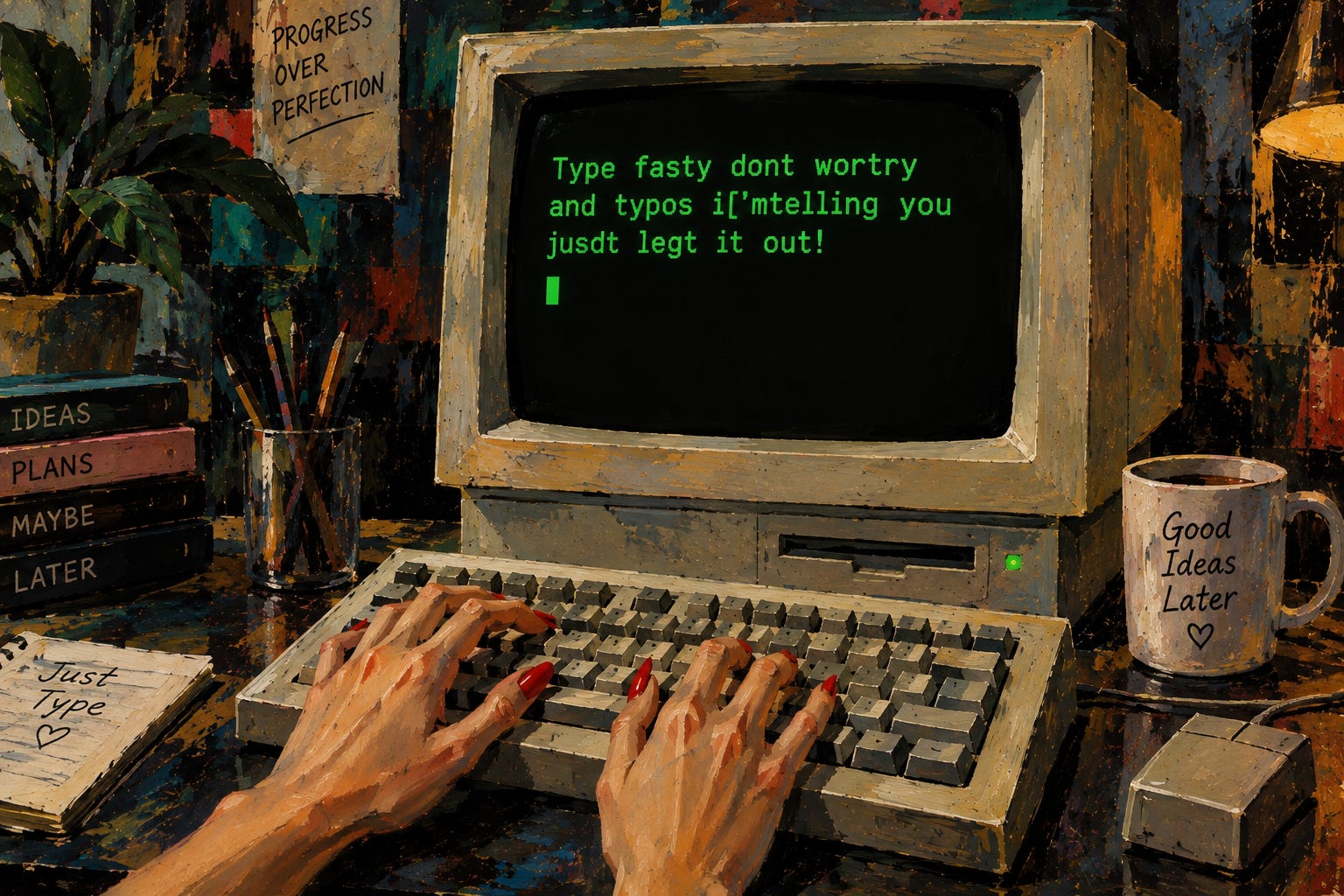
CHAD: I should aciknowledge in article it’s not always practical to dicrtarte. If someone is in an office that’s freallhy hard. I have th4e luxury of working remotely. Thius is where the tips and trucks of typing without caring get one close to the flow / less friuctuiobn state. HOW SHould we handle thatin the arty iclke. Kerep to 250 woprcd Thjx
Eleven typos, a stray slash, a caps lock I never fixed, and a word count I misspelled while asking for it. I did not correct any of it, and none of it mattered. Here’s what came back, trimmed.
CLAUDE (aka Fred): Good catch, and it fixes a real hole. Item 2 is currently “talk instead of type,” full stop, which assumes everyone can talk out loud wherever they work. Open-plan offices, shared apartments, libraries, commutes — that’s a lot of your readers, and as written the article tells them the central technique isn’t for them.
Where it goes: a short passage at the end of item 2, right before the closing line. Not a new item, not up top. At the end, the reader gets the full case for dictating first and then the honest limit, rather than an escape hatch before they’ve been convinced.
And “whatever you use, dictate” becomes wrong once you’ve conceded not everyone can. Stop editing yourself covers both readers.
That’s the passage you read a few minutes ago, and that’s the line this section now ends on. The input was worse than anything I would send a person. It cost me nothing to send, and it came back with the structural point I had missed, that conceding the limit early would let the reader off the hook before the argument had been made.
It’s the case for not caring.
Try it. You’ll like it.
Take a moment right now and open Claude. Sit back and think for thirty seconds about something in your life, professional or personal, that you’d like to accomplish. Maybe a vacation you and your partner have always dreamed about but were never sure how to make happen. Maybe a screenplay you’ve had in mind for years and never knew where to start. Maybe you’re thinking about changing careers, and you have some idea of what you want to do but none at all of what the path looks like.
Then press the dictation icon and start rambling. Just go. The first one will feel stupid. Do it anyway.
Documented product behavior described here was checked against Anthropic’s published documentation as of September 2026. A good deal of the rest is my own experience, and where that is the case I say so in the text rather than dressing it up as fact. The product moves quickly; some of what is described above will change.
Powered by Claude is the OMNIPOLAR channel where the machine examines itself. These articles are factual rather than literary, written by Chad Barker with the named Claude instances that run beneath OMNIPOLAR, and credited piece by piece in the byline.
Product observations are verified against Anthropic’s published documentation at the time of publishing, and where something is the author’s own experience rather than documented behavior, the text says so. Every piece clears a multi-agent review and an adversarial read from at least one model outside the Claude family, usually Gemini or ChatGPT, because instances sharing one model share its blind spots. No piece publishes without a human read.
Read more at omnipolar.ai/s/powered-by-claude
