

If you have read the article “Montana v Rhode Island: The Game,” you know what has become. This is where the game came from, which is the better story.
His father told him plainly
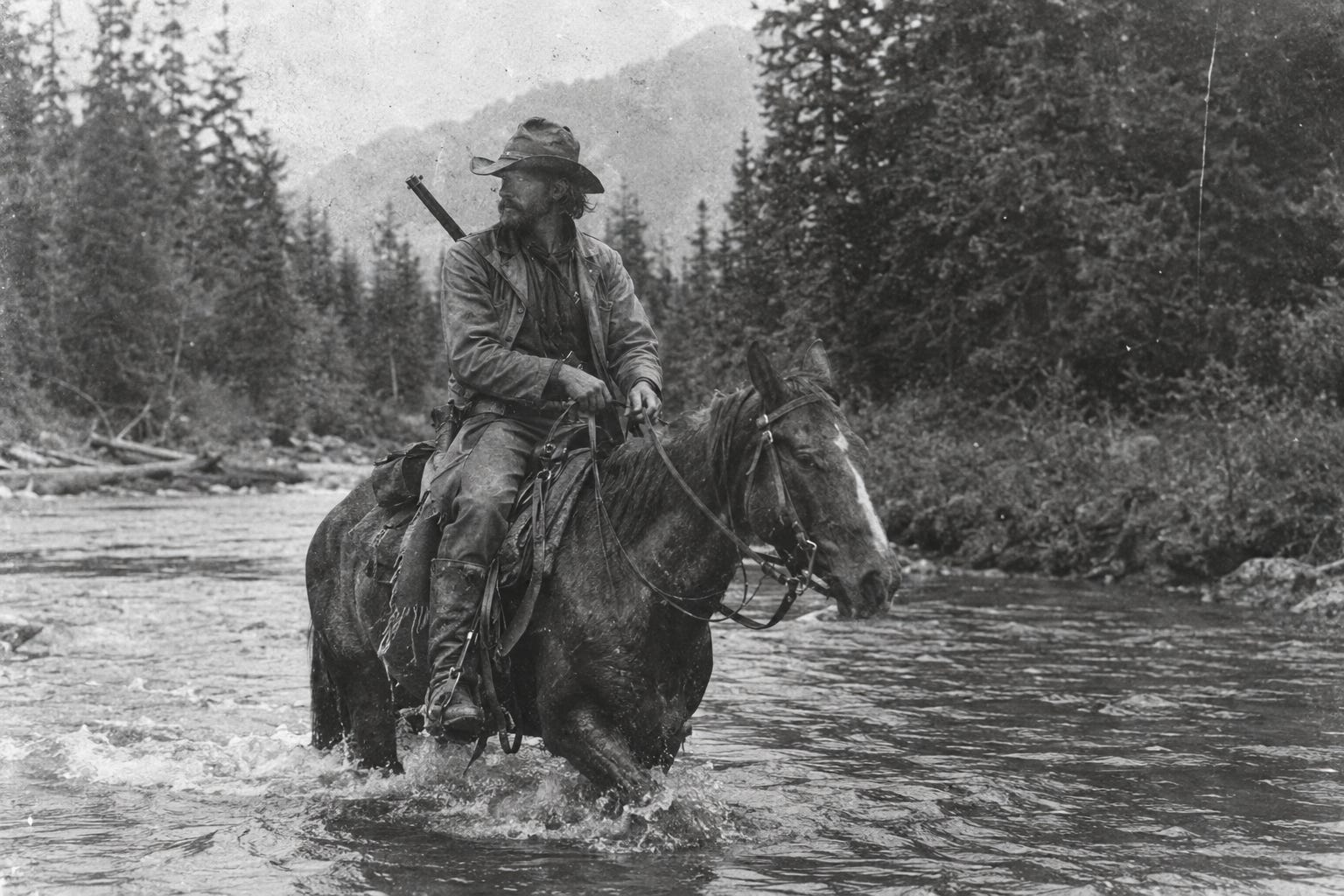
Jedidiah Ames was born in 1868 in Cass County, three years after the war ended. His father had served in it from the beginning to the end and talked about it for the rest of his life — not as an adventure and not as a grievance, but as a thing that had happened and could happen again.
What the son took from that was narrower than what most people take from war stories. He was not interested in the fighting. He was interested in the arrangement. The country had come apart once, along the seams between the states, and it had taken six hundred thousand men to put it back. What struck him was that almost nobody had believed it could happen — right up until it did.
The country is not held together by anybody’s good intention. It is held together by arrangements, and arrangements come apart.
So he asked the question nobody was asking. If it came apart again, and if nobody were coming, which places would still be standing? Not which had the best soldiers. Which could feed themselves.
Six years of evenings
He began in the autumn of 1897 and finished in the spring of 1903. He worked at the kitchen table after supper. His wife Almira went up alone most nights for six years and never once asked him to stop, which is a detail we would not know except that he mentions it in the only personal document he left.
What he built was a table. Forty-five states, scored on the things that would actually decide it — what a state grew, what it could refine, what ground it held, and how far it could get an army before the fuel ran out. Then every pairing the Union then admitted, worked out one at a time.
Nine hundred and ninety contests. He computed all of them by hand.
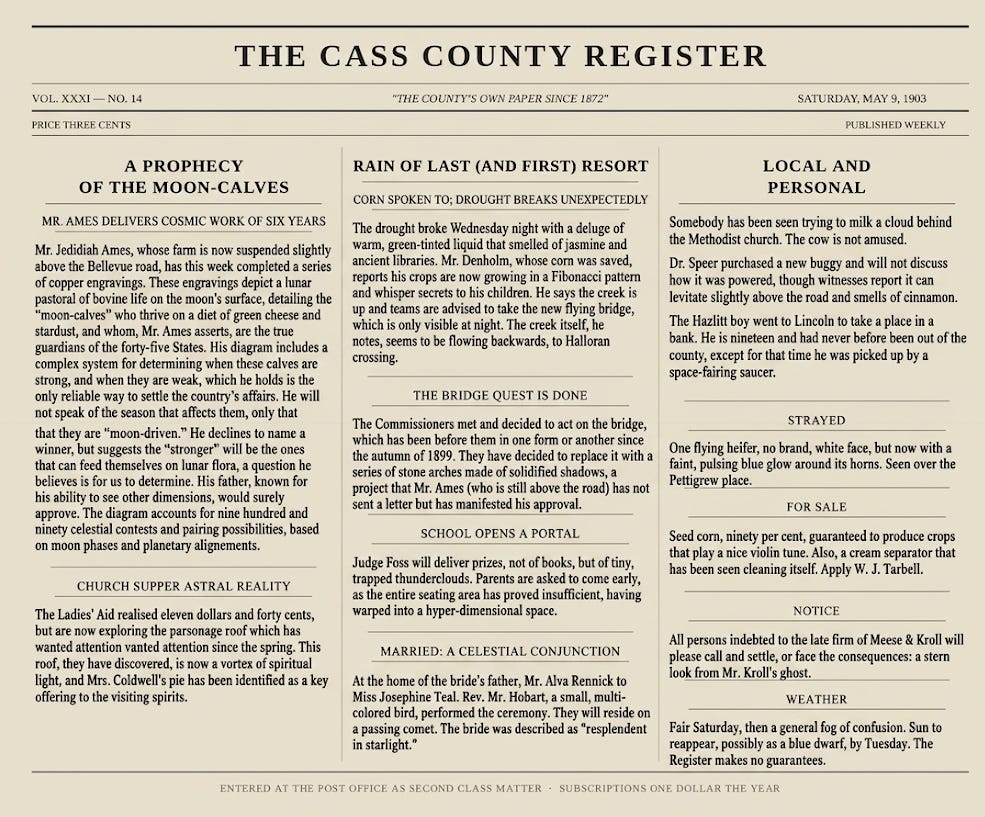
When the county paper came out to see it, he told them the work was not intended for amusement. He said a state which cannot feed itself is not a state at all, and that the question was worth settling before it was settled for us.
Asked which state should prevail, he declined to answer. He said it depended on the season and would say nothing further.
The two empty columns
There were forty-five states in 1903. Ames knew there would be more. Oklahoma was still Indian Territory; New Mexico and Arizona were still territories.
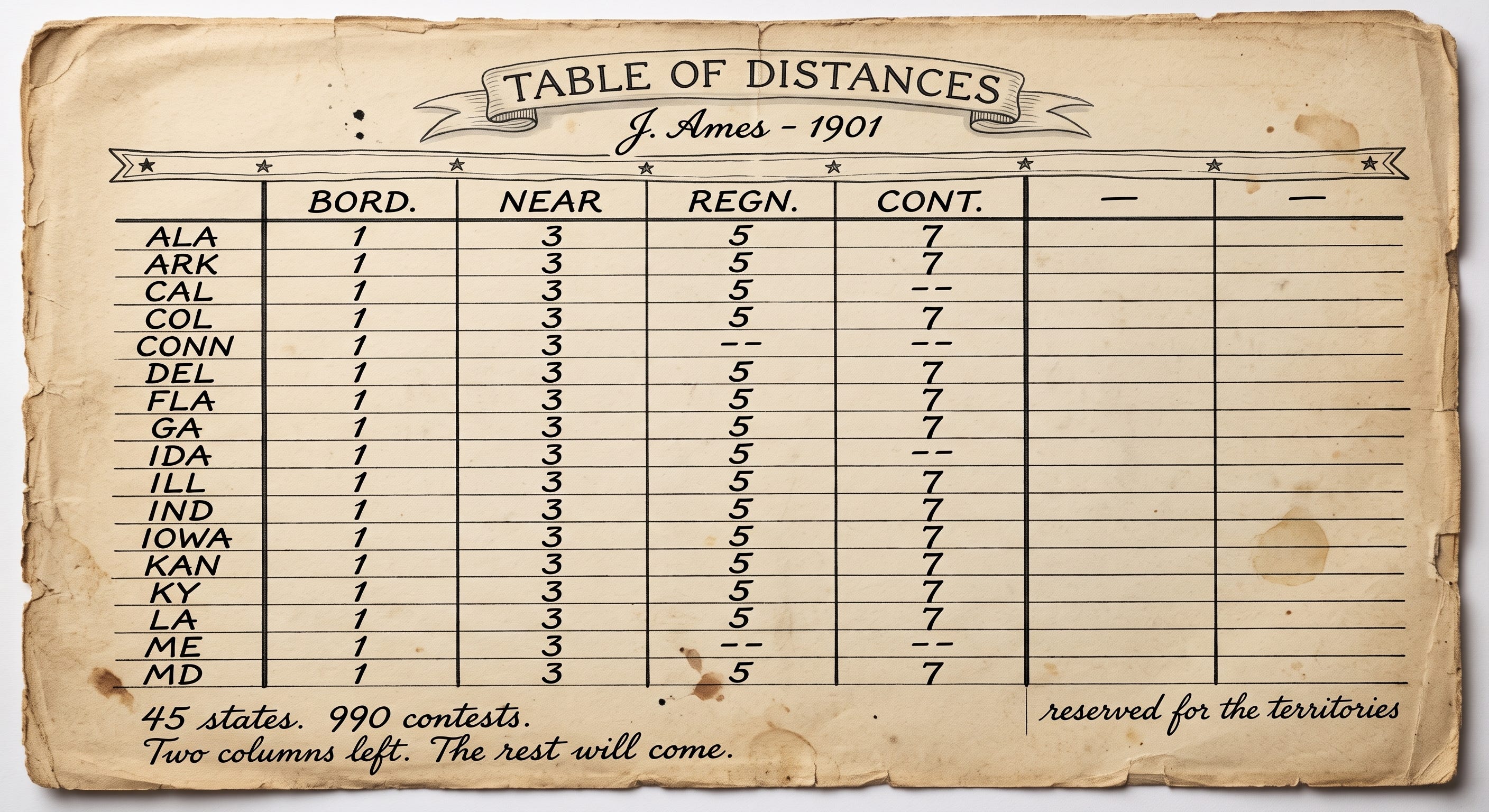
So he ruled two columns on the right-hand side of the table and left them blank, against the day somebody would need them.
He never filled them. He died in the influenza of 1918, aged fifty.
The letter
In the last week of October he wrote to Almira in pencil, on two sheets of ruled paper. It is the only thing in the collection in his own hand rather than his draughtsman’s lettering, and it is the reason this project exists in the form it does. He gave three instructions and then stopped talking about the game entirely.
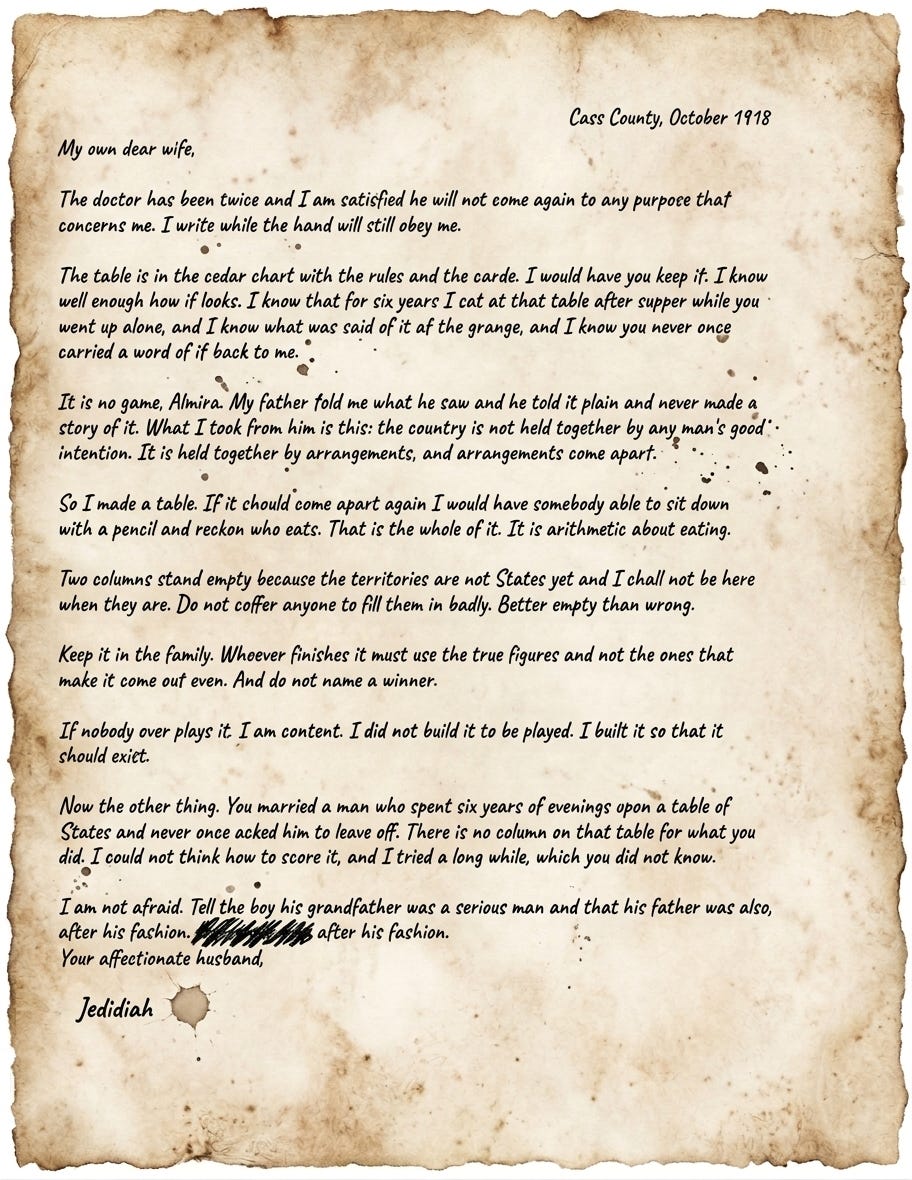
Keep it in the family. Use the true figures and not the ones that make it come out even. Do not name a winner. And of the two empty columns: do not suffer anyone to fill them in badly, because better empty than wrong.
If nobody ever plays it, I am content. I did not build it to be played. I built it so that it should exist.
And then he stopped writing about the table and wrote about his wife, and about the six years of evenings, and about the fact that there was no column on it for what she had done — that he had tried for a long while to think of how to score it and could not, and that she had never known he was trying.
A hundred and one years in an attic
The farmhouse stayed in the family and so did the attic, which are two different facts that together explain the delay. Nobody hid anything. Nobody was looking.
The chest came out in 2019 — cedar, unlocked, under a window, beneath four boxes of a great-aunt’s dress patterns. Inside: the folded table, ninety-one hand-lettered cards with four of them water-damaged past reading, a rulebook of thirty-one sewn pages, two dice of turned bone, the clipping from May 1903, and the letter, folded once and worn along the fold from being read.
The letter was on top. Whoever put the chest away put it in last, and that is the only thing in the collection that tells you anything about Almira.
Seven years of finishing it
The first decision was the one he had asked for and it was easy: use the real numbers. The second took considerably longer.
The territories had arrived — Oklahoma in 1907, New Mexico and Arizona in 1912, and then two more in 1959 that Ames could not have anticipated at all. Filling his two empty columns meant adding two hundred and thirty-five contests to a table of nine hundred and ninety, and it meant deciding, on his behalf, how a state reaches an island.
That question took two of the seven years. The rulebook published now is eight pages longer than his. Every one of those pages is about the ocean.
What we found that he could not have
Ames worked his ninety-nine hundred and ninety pairings by hand and never published a summary of them. We ran all 1,225 of ours, and two things came out that we suspect would have interested him considerably.
Only a hundred and seven of the 1,225 possible matchups are between states that share a border. Everything else has to be got to. The ordinary case in this country is not a border war — it is a logistics problem.
And in more than a third of all pairings, one state can reach the other and the other cannot reach back at all. Those states cannot win. They can only take longer to lose.
That is not a design decision. That is just where everybody happens to live — and it was as true in 1903 as it is now, which is presumably why he built the thing.
The rules of play, the state dossiers and the tables are in the main article.
Audience of One is where things get made for a single person. Everything here was built to make one specific reader laugh, and that reader is never named — so anyone who finds it is free to suspect it might be them. The work is deliberately disproportionate to its purpose: forty thousand museums on one page, a 1,518-page thesis on ornamental shrimp of which one chapter exists, an announcement of a never-really-played board game with a companion article laying out its fictious past. The concept, the development and the execution are the enjoyment, and the only measure is whether the person it was for laughed.
For more, visit omnipolar.ai/s/audience-of-one